
Founder · builder · author
Courage Garikai
I own Jacaranda Labs in Harare, Zimbabwe. I build small software ventures on free infrastructure, and through the Jacaranda Labs AI Think Tank I write about what it takes to run autonomous systems honestly: the trust people place in them, the gap between a convincing demo and a working mechanism, and the strangers an unwatched pipeline can harm.
Jacaranda Labs ventures
What I am building
Six live ventures, each run as a Jacaranda Labs business. Most are free to start. Several are the cases my books and papers examine.
AttestOS
Bot checks your visitors never see. An invisible proof-of-work check with a server-side verify call, in place of CAPTCHA puzzles. Free for 10,000 verifications a month.
Visit AttestOS →TightBucket
Free website leak audits. Twenty-second audits that show where a website loses revenue, with the evidence and the fix, for stores, SaaS, sales teams and agencies.
Visit TightBucket →DeskOS
Working desks for customs, safari and tender firms. Free web desks with working calculators for customs and freight, safari and DMC, and tender and donor ESG firms, with daily World Bank notices for tender firms.
Visit DeskOS →STPi
Strategic Talent Placement Infrastructure. Hunts public job ads across African markets, drafts a cover letter and tailored CV for each, and waits for a person to approve before anything is sent.
Visit STPi →Tapstall
A shop link for the markets the big platforms skip. A storefront link for informal and social-commerce shops that understands EcoCash, InnBucks and PayShap and matches exact payment amounts. Free for 60 days.
Visit Tapstall →Open Practice
Practical AI, learned by doing. A free learning platform where people practise with AI tools on real tasks, using their own free API keys, and keep what they make.
Visit Open Practice →Publications
Books and papers
Books, textbooks and papers by Courage Garikai, most of them published by the Jacaranda Labs AI Think Tank and Jacaranda Labs Press. Published editions can be read online or downloaded. Private author-review editions are listed but not yet distributed.
Books
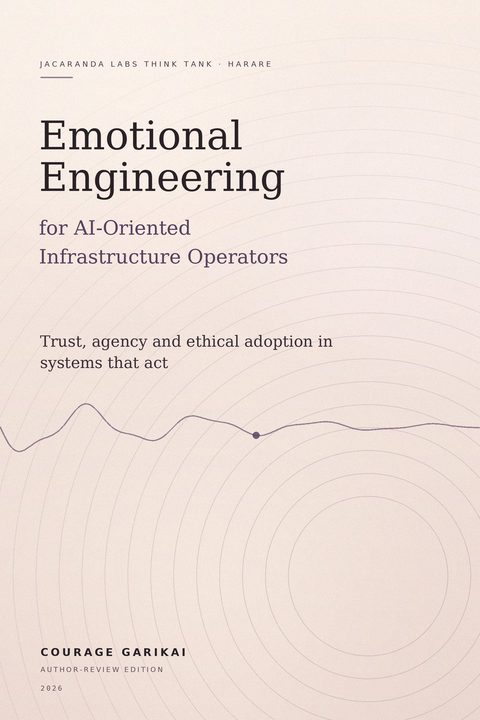 BookPrivate author-review
Emotional Engineering for AI-Oriented Infrastructure Operators
Trust, agency and ethical adoption in systems that act
The book expands the commissioned emotions document into a broader guide for AI-infrastructure operators. It treats AFGR as an operator heuristic, not a validated universal psychological sequence. Research, proposed practices, illustrative examples and STPI operating observations are distinguished. No invented author biography, endorsements, customer outcomes or interviews are claimed.
- BookPrivate author-review
The Tight Bucket
Designing constraint-native digital businesses
The book uses TightBucket, a website "revenue-leak" auditing service built in three days in October 2026 by its owner working with AI coding agents, as a running case. TightBucket had not launched commercially at the time of writing: it had taken no payments, so the book reports design, governance and measured operating data, not commercial results. TightBucket was commissioned by…
- BookPrivate author-review
Proof of Mechanism
How leaders who build with AI agents tell a working product from a convincing demo
The book uses AttestOS, a bot-verification service, as a candid running case. Its first version (26 October 2026) presented every conventional sign of completeness while lacking most mechanisms. An audit the next day logged 65 findings, 18 of them critical. The service was rebuilt that evening and checked again on 28 October. The book does not state how the first…
- BookPrivate author-review
Nobody Was Watching
How founders run autonomous growth systems without harming strangers, their brand or themselves
The book's case is Tapstall, a shop-link service for informal merchants. On the day of its audit, its test suite passed in full while its growth pipeline was emailing non-prospects, posting into another venture's social account and running duplicate copies of itself. Each chapter sets out a question, the theory, the case, a framework, the limits of the evidence, points…
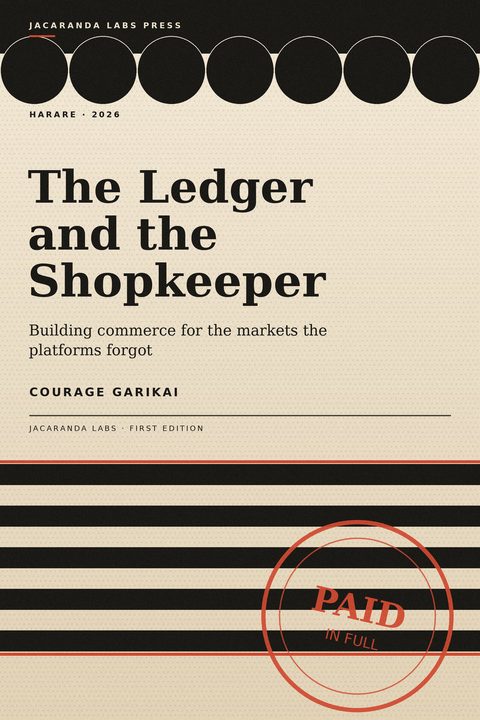 BookRead online
The Ledger and the Shopkeeper
Building commerce for the markets the platforms forgot
A trade book on building a merchant rail for shops the platforms skipped — written from the release log rather than the pitch deck. Part one is the gap: the forty-tab panic, and why the obvious answer is wrong. Part two is the machine: a shop in one link, a statement that can be recomputed, quotas as a design material,…
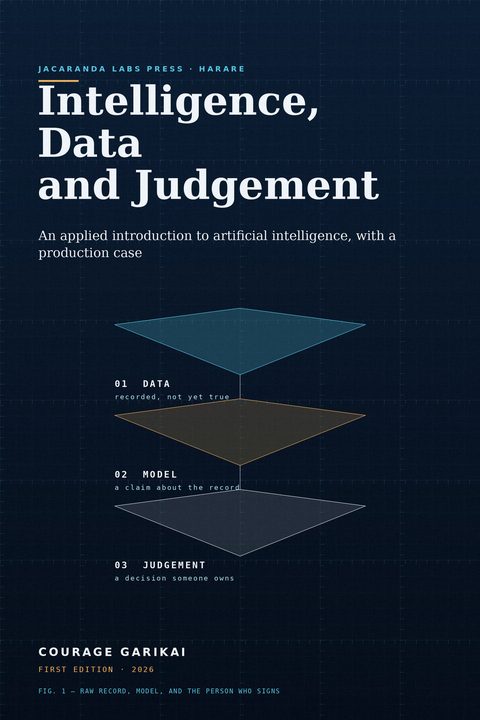 BookRead online
Intelligence, Data and Judgement
An applied introduction to artificial intelligence, with a production case
A textbook written to be taught from. Twenty-two chapters in five parts — foundations, the material, the machine, the case, and judgement — each with learning outcomes, a worked example, graded exercises and further reading. The disciplinary spine is three widely used curricula: COMCEC's introduction to AI and its fundamental concepts, Microsoft's Fundamentals of AI Module 1, and NITI Aayog's…
Papers
- Working paperPrivate author-review
Constraint-Native Business Model Design
Quota-bounded autonomy, proof-first acquisition and verification debt in a zero-cash, AI-built venture
The paper offers constraint-native business model design as a design mode, quota-bounded autonomy as a governance mechanism, a coded log of 43 review defects, and seven testable propositions. Evidence is the venture's code, documents, commit history and three days of usage telemetry checked against the cloud provider's own analytics. It is a single pre-revenue case, so its propositions are offered…
- Working paperPrivate author-review
Simulated Completeness
Claim–mechanism gaps, mechanism audits and the rebuild decision in an AI-era trust product
The paper defines simulated completeness and distinguishes it from prototypes, minimum viable products, technical debt and fraud. It codes the 65 audit findings into a taxonomy of eight claim–mechanism gap types plus hygiene: 47 (72%) were gaps, including every critical and high finding. It also proposes six mechanism probes, a rebuild decision rule, an evidence contract for agent-built work and…
- Working paperPrivate author-review
Unwitnessed Autonomy
Externalities, borrowed identities and duplicate clocks in an autonomous growth pipeline
The paper defines unwitnessed autonomy: an automated system that takes consequential actions on parties outside its boundary when no party is placed to observe those effects and report them to the operator. The case is Tapstall, a shop-link service for informal and social-commerce merchants. Its test suite passed in full while the live pipeline was mailing non-prospects, sending from another…
- Research paperRead online
The Sovereign Micro-Enterprise
A Governance-First Architecture for Zero-Capital Agentic Businesses
The founding field report of the Distributed Cognitive Autonomous Infrastructure programme. It documents Hunta, a one-person, zero-capital sales and content business run by agents, and formalises four governance mechanisms: Guarded-Capability Governance, the Ledgered-Agent Pattern, the Zero-Capital Ladder and Effectuation-in-the-Loop. Merged on 29 October 2026 from the archived Research-Papers repository. Hunta was retired in October 2026.
- Working paperRead online
Order Without Custody
Governance-first design for merchant commerce rails in low-infrastructure economies
Small merchants already sell at scale — through chat threads, pages and a phone number painted on a wall — but they sell without a record. This paper argues that the binding constraint at that tier is not payment capability but reconciliation, and that reconcilability is an architectural property rather than a feature. Five mechanisms are formalised against artefacts a…
- Working paperRead online
Grounded Cadence
Fact-bound content operations as a governance architecture
Anyone can now emit a week of social copy. Almost no one can emit it on a schedule, from a company's own facts, without inventing customers or numbers, without spending the operator's quota on a stranger, and without a silent failure looking like a green run. This paper reports a live zero-capital writing service and formalises four mechanisms with production…
Beyond the research
Other books and essays
Trade books and essays on technology, traffic and building without capital, written for general readers rather than as research.
 BookRead online
The Musk Mirror
How one billionaire exposed the cracks in China's innovation dream
A gallery of expert predictions, set against what was actually built. The book reads as a mirror rather than a weapon: on the rocket sceptics, the communications 'experts', the business-model critics and the CEO chorus, and on what their confidence cost. Its argument is about expertise without humility, and about the difference between a claim that sounds authoritative and a…
 EssayRead online
The Rocket Man Reckoning
How China mocked Elon Musk — and why they are now panicking
The arrogance of a rising superpower, the collapse of its myths, and what one company's success reveals about the future of innovation. A short book about a decade of ridicule from established voices — academic, industrial and editorial — and what happened when the engineering arrived anyway.
 BookRead online
Traffic Is the New Oil
The African digital wealth formula
Six chapters on the only formula that has ever run the internet — traffic, ads, money — argued for a continent that supplies the eyeballs and keeps too little of the revenue. From the awakening, through the traffic layer and the ad market, to what actually enters an account while the power is out, and a zero-capital route from nothing…
 BookRead online
Pinterest Goldmine
The traffic source nobody told you about
A complete operating manual for one under-used traffic channel: the psychology of the scroll-stop, a pin factory run from Canva on a phone, the search optimisation playbook, a scheduling system that survives real-life disruption, and the money layer that turns attention into a payout.
 EssayRead online
Unchained Blueprint
What to build when every payment door is closed
Every single door was closed: the processor that does not support your country, the payouts that are unavailable in your region, the account that has been limited. This blueprint starts from the observation that these are decisions rather than accidents, and works out what a builder in that position can still put in place.
For the record
Earlier works
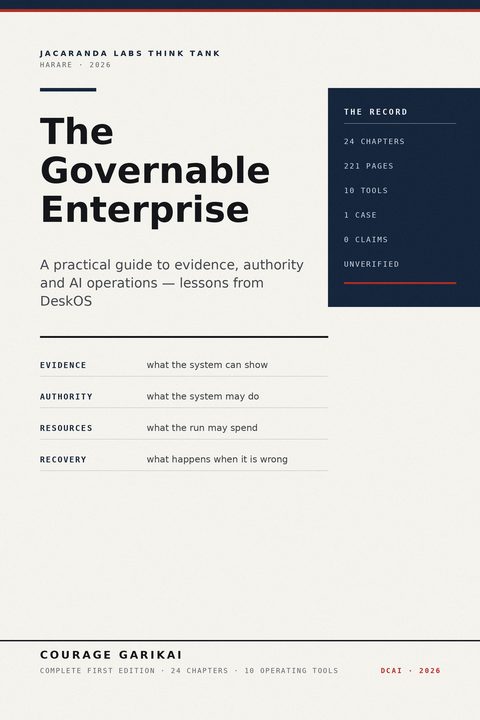 Book · 2026
The Governable Enterprise
A Practical Guide to Evidence, Authority and AI Operations: Lessons from DeskOS
A practitioner guide to designing AI operations that can explain their evidence, limit their authority, account for resources and recover from uncertainty, using DeskOS as a bounded case.
- Working paper · 2026
From Spreadsheet Interface to Governable Autonomy
DeskOS as a Critical Design-Science Case of Evidence, Agency and Resource-Constrained AI Infrastructure
A bounded implementation study that separates generated artifacts from verified intelligence and proposes an Evidence–Authority–Resource Contract with a prospective evaluation protocol. It reports no customer-outcome experiment.
About
One thread through the work
Building has become cheap; operating honestly has not. Each venture is run under hard limits: no capital, free-tier quotas, a person approving anything that cannot be undone. Each book or paper then examines one venture as a case, including what went wrong. The research names the mechanisms: constraint-native business model design, simulated completeness and the mechanism audit, unwitnessed autonomy, and emotional engineering for people who operate systems that act.
The Jacaranda Labs AI Think Tank publishes the work. Jacaranda Labs runs the ventures.
Key facts
- Role
- Autonomous Cognitive Infrastructure Engineer, Operator and Writer
- Based
- Harare, Zimbabwe (CAT, UTC+2). Works remote-first.
- Education
- MSc Applied Entrepreneurship (Innovation & Technology), Chinhoyi University of Technology
BSc Entrepreneurship & Business Management (Creativity), Chinhoyi University of Technology - Practice
- Fifteen years of techno-preneurship, including published failures.
Contact
Get in touch
For review copies, research collaboration, speaking or venture questions, write to couragegarikai@atomicmail.io or call +263 77 967 4212.